Seven Dimensions, One Frame: Why I Don't Animate My Landscapes
There's a question I get more often than almost any other, usually from people who assume the answer will be obvious: "Your work is born digital — why not animate it? Why not let people move through it, zoom into it, watch it breathe?"
It's a fair question. And I understand exactly why it gets asked, because last week I stood inside Refik Anadol's Dataland in Los Angeles and found myself thrilled by the answer someone else has given to it. Anadol's data-driven, ever-shifting environments are a genuine achievement — a high watermark for what immersive digital landscape art can be. I don't say this as a hedge before disagreeing. I say it because admiration and divergence can coexist, and mine do.
The author at Refik Anadol’s Dataland in Los Angeles (Video by George Joblove)
But my own ambition points somewhere else entirely.
The problem I actually care about
Here is how I think about a great landscape — a real one, the kind that stops you mid-step. It isn't three-dimensional. It's seven-dimensional. There's the space itself, yes — height, depth, breadth. There's time: the particular slant of light, the season, the minutes you spent standing there before the feeling arrived. And there's everything that space and time provoke in you — emotion, cognition, memory — the way a canyon wall can suddenly resemble your grandfather's hands, or a stand of aspens can deliver you, without warning, back to a summer you'd forgotten you were still carrying.
That's the real experience. Seven dimensions, tangled together, mostly unrepeatable.
The problem I've set for myself — the one that has quietly organized fifteen years of work — is how to translate that seven-dimensional experience into a static two-dimensional image and lose as little of it as possible in the crossing. Not represent the place. Not document it. Translate it, the way a poem translates a feeling rather than merely describing it.
This is, as far as I can tell, exactly the problem the great landscape painters were solving. Church didn't paint "The Heart of the Andes" so that viewers could tour the Andes. He built a single, frozen, five-and-a-half by ten foot argument that the sublime could be held still long enough for someone to be changed by looking at it. People lined up around the block in 1859 to stand before that argument. Many of them wept. Nobody was zooming or panning. Nobody needed to. The stillness was the point — it's what let the image go to work on them.
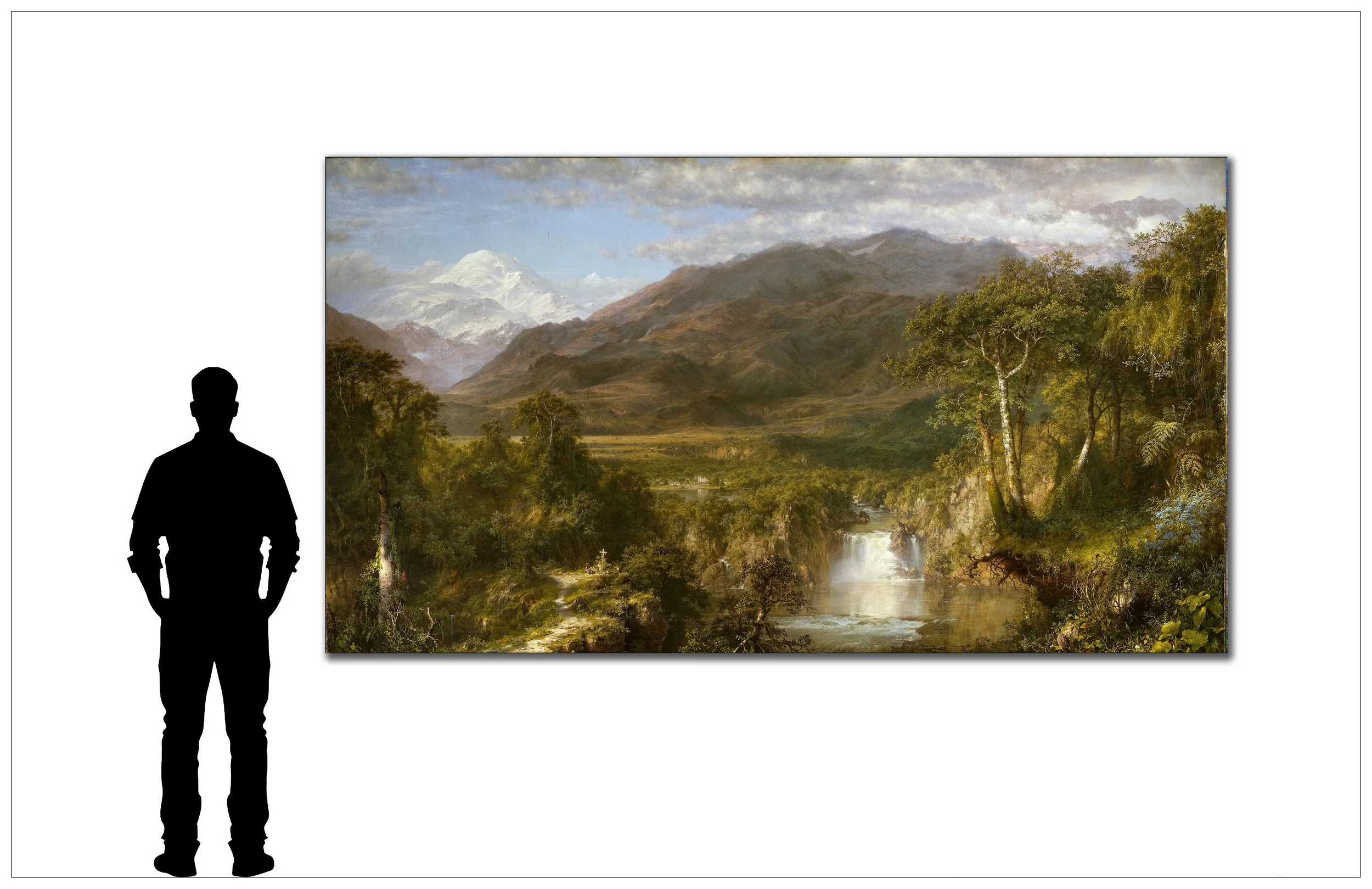
“The Heart of the Andes” by Frederic Edwin Church (66.1 in x 119.2 in)
Why motion would be a concession, not an enhancement
I think there's a temptation, when you're working in a native digital medium, to treat every static choice as a limitation waiting to be lifted — as if the "real" version of a digital landscape is always the animated one, and a still image is just that experience with the good parts removed.
I don't see it that way. Animation and immersion solve a different, also worthy, problem: how do you surround someone with a place. That's Anadol's problem, and he solves it beautifully. But surrounding someone is not the same as translating an experience into a single, unmoving image that carries the whole seven-dimensional weight of the original on its own. If anything, motion is a kind of mercy — it lets the piece keep doing new work every second, so no single instant has to carry everything. A static image doesn't get that mercy. It has to succeed in one frozen configuration or it doesn't succeed at all. That constraint is precisely what draws me. It's harder, and it's the harder problem I actually want to be solving.
So when I print my Dreamscapes onto fabric at grand scale — eight, twelve, sometimes sixteen feet across — I'm not choosing "away" from my medium's native strengths. I'm choosing toward the oldest and, to me, still the hardest ambition in landscape art: to make a viewer stand still in front of something that is itself standing still, and have that be enough. I want the same thing that happened to Church's audience to happen, in some small way, to whoever finds themselves in front of one of my pieces — the involuntary pause, the sense of having been quietly relocated without moving your feet.
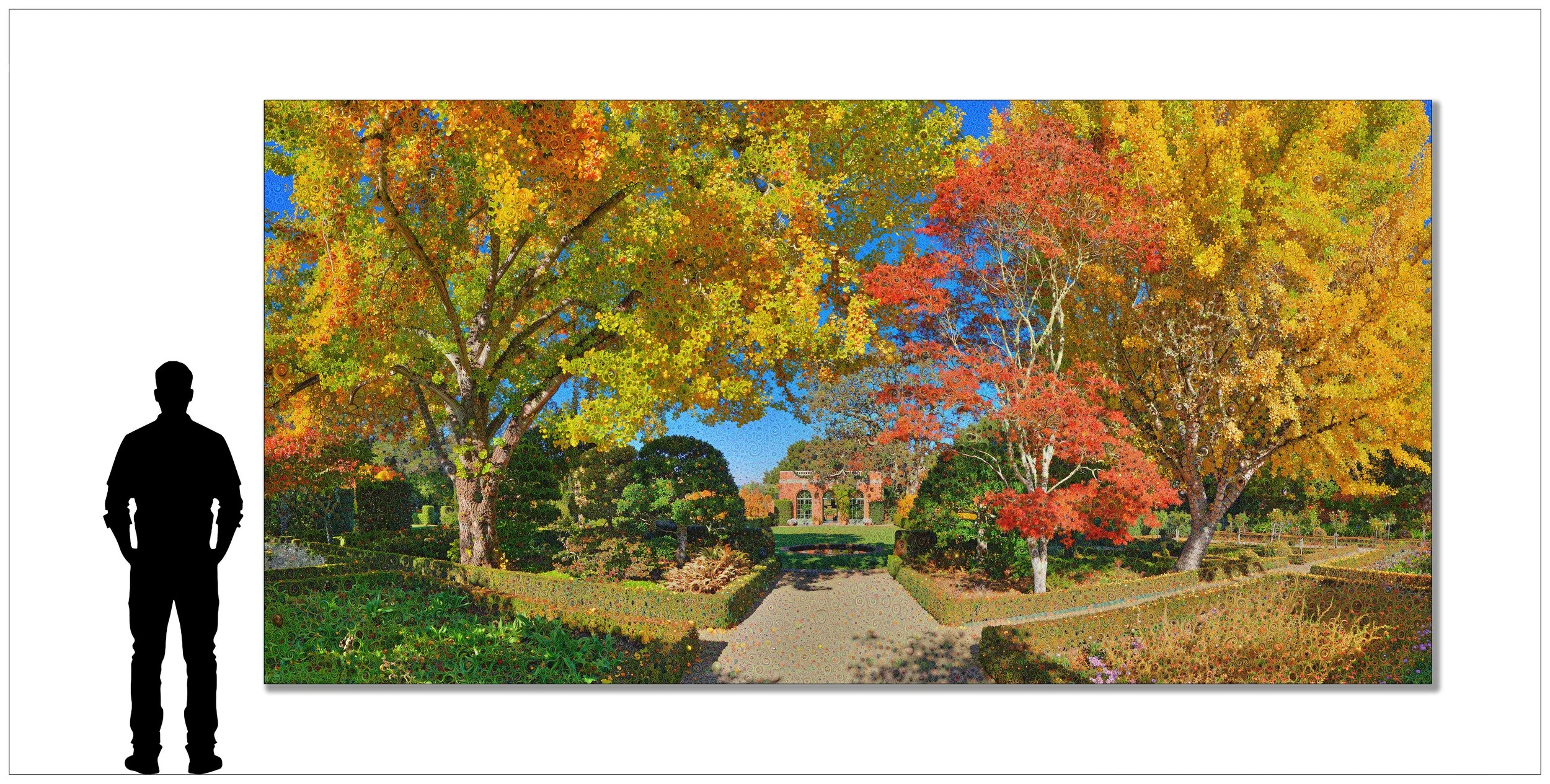
“Filoli Gardens Dreamscape” by Daniel Ambrosi (96 in. x 192 in.)
What "static" is actually asking of the work
None of this is nostalgia for canvas, and it isn't a rejection of the tools I use. The neural network architecture behind these pieces is entirely of this century. But the ambition is not new at all — it's the same one the Hudson River School painters and the Romantics and the Impressionists were chasing, and I think it deserves to be chased in the same currency they used: one image, no loop, no pan, nowhere else for the eye to go but deeper into the frame that's already in front of it.
That's the whole game, as I understand it. Take something that unfolds across space, time, and the interior weather of a human being witnessing it — and compress it, without flattening it, into something that can hang on a wall and still, somehow, hold all seven dimensions inside two.
I don't know that I'll ever fully solve it. I'm not sure Church did either — I just know that when I stand in front of "The Heart of the Andes," something in me believes he came very close. That's the target. Everything else is method.