Three Museums, Three Strangers, Three Masterworks
A couple weeks ago I ran a quick loop through three museums I'd never set foot in before — the Museum of Fine Arts, Houston; Crystal Bridges in Bentonville; and the Nelson-Atkins in Kansas City.
After fifteen years of steeping myself in the four-hundred-year tradition of landscape painting, I can usually name the hand behind a canvas from across the gallery before I've even reached the wall label. It's a party trick I don't get to show off as often as I'd like, because it's rarely wrong.
So imagine my delight when, at each of these three museums, I rounded a corner and was stopped cold by a landscape whose maker I had never once encountered — not in a book, not in a lecture, not in fifteen years of sauntering through collections. Three museums. Three unfamiliar names. Three genuinely stellar paintings. That kind of streak doesn't happen. Until, apparently, it does.
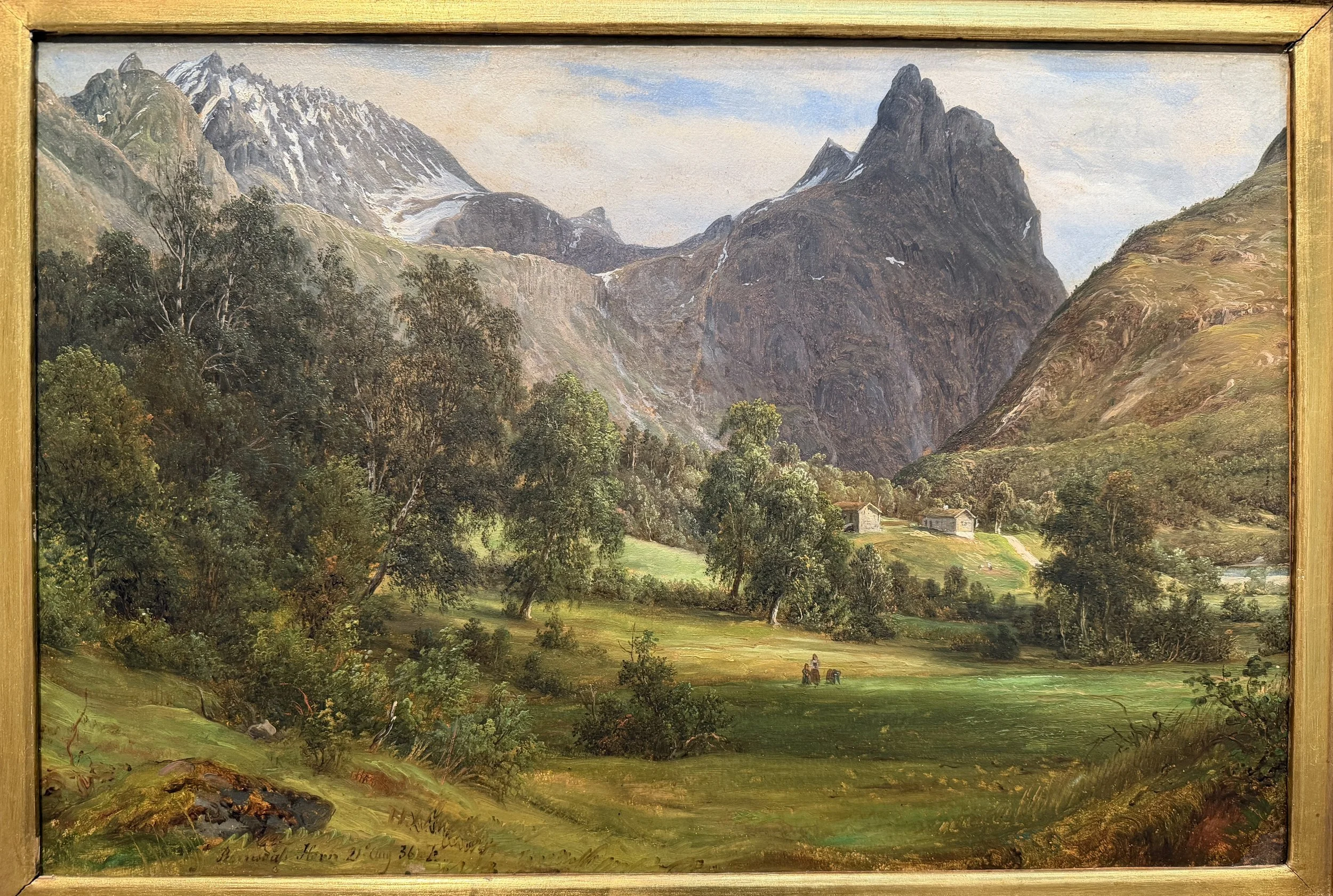
Thomas Fearnley, Romsdal with Romsdalshorn, 1836 (Museum of Fine Arts, Houston)
First up was this Norwegian romantic, a name that had somehow never crossed my path despite a career built on exactly the kind of sublime alpine terrain I've spent a lifetime chasing. Fearnley had the run of Europe — the Bavarian Alps by 1830, the Swiss Alps in 1835 on his way from Italy to Paris — and it was his teacher, Johan Christian Dahl, who first planted the fascination with dramatic mountain scenery back in the 1820s. A decade later, Fearnley turned that same eye on his native Norway, returning again and again between 1836 and 1838 to paint the Romsdal valley and the towering horn that gives this canvas its name. Standing in front of it, I felt the particular vertigo I go looking for in this genre — jagged granite catching the last cold light above a soft green valley floor, dwarfing the tiny figures working the field below.
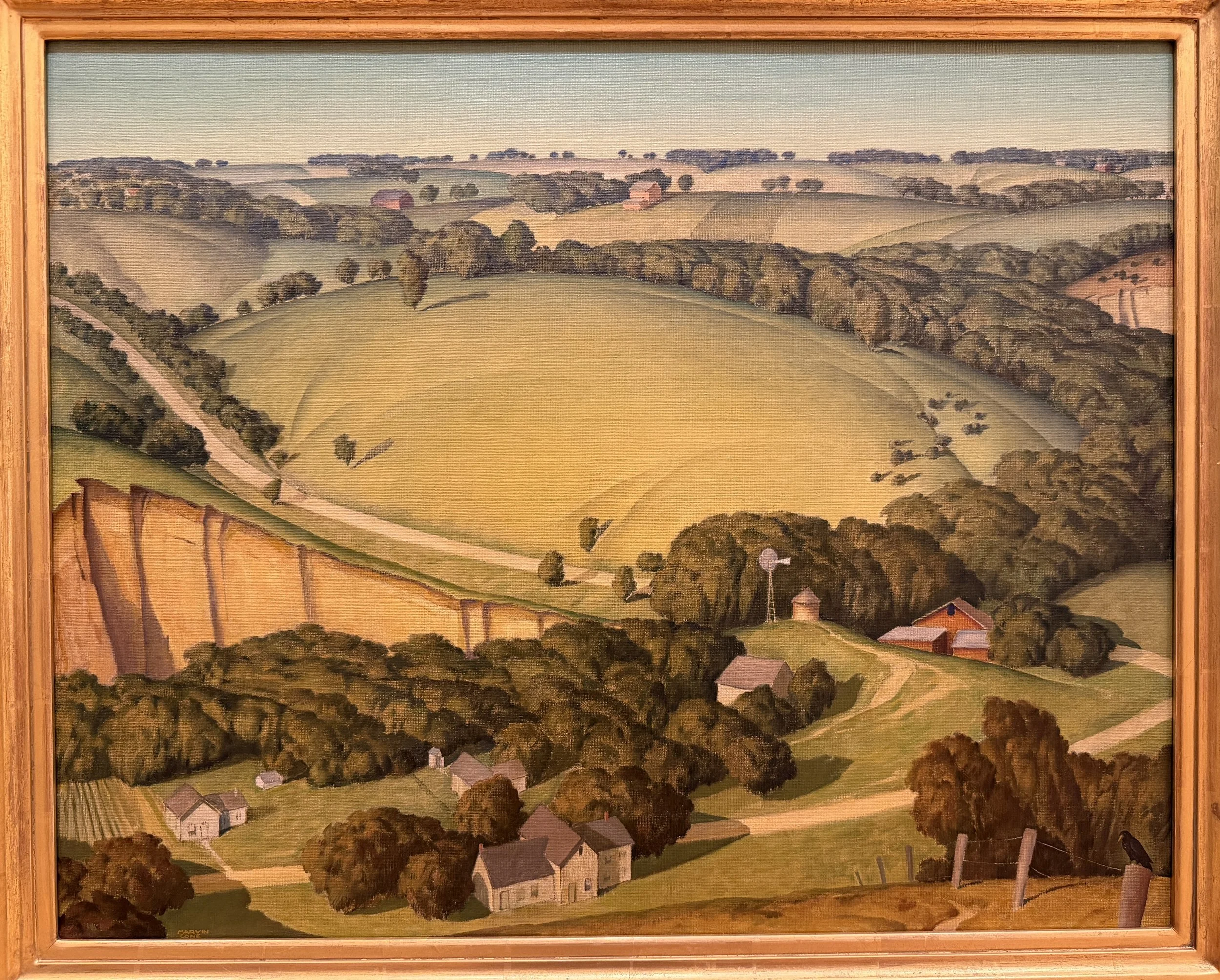
Marvin Cone, Stone City Landscape, 1936 (Crystal Bridges, Bentonville)
The second ambush came courtesy of an Iowan I'd somehow never crossed paths with. Cone found this rolling, sun-bleached terrain near his home in Cedar Rapids, and the painting shares its DNA with a companion piece by George Ault, who was working similar snow-blanketed farmland near Woodstock, New York — both artists chasing the same hush and solitude of rural life, both keeping their scenes empty of people, aside from a single crow perched in Cone's foreground. What got me, standing there, was how unmistakably this painting rhymes with Grant Wood — the same undulating, almost sculpted hills, the same crisp stylized contours and flattened, deliberate shading, the same way the topography itself seems to breathe and swell like something alive rather than merely surveyed. It's no accident, of course — Cone and Wood were close friends and fellow Cedar Rapids regionalists — but I hadn't expected to feel Wood's fingerprints this strongly in a name I didn't already know.
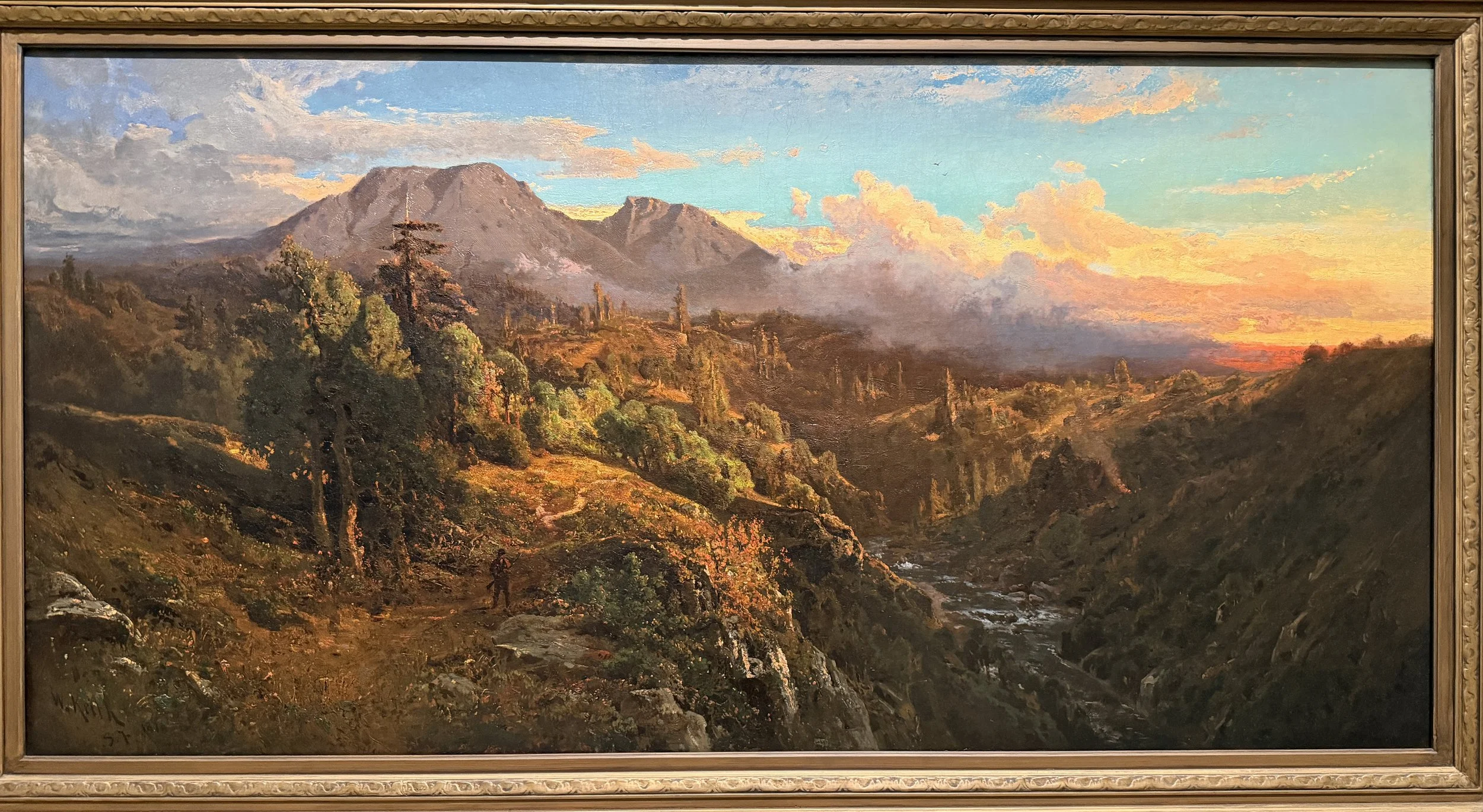
William Keith, Sunset Glow, 1896 (Nelson-Atkins, Kansas City)
And then, in Kansas City, a Scottish-born Californian rounded out the trifecta. Sunset Glow lays out a forested, mountainous stretch of California about to be swallowed by evening cloud, with a lone hunter working a winding trail through the lower left that threads him into the vast panorama beyond. The scene reads as topographically faithful, but Keith wasn't really in the business of transcription — he believed an artist should approach nature the way a poet does, selecting and combining rather than simply recording, so the impression lands harder. That instinct came partly from George Inness, whom he met in 1891, and it was nurtured further by his friendship with John Muir. You can feel both influences in the canvas — Inness's atmosphere, Muir's reverence — wrapped into one glowing, quietly monumental evening.
Three museums, three names I'd never heard, three paintings I won't forget. The tradition is deeper and wider than I'll ever fully map, and I'll take that as a gift rather than a gap. There's always more out there to be surprised by, if you keep sauntering.